Why is DonateOpen a donation service of a different generation?
DO is more than a donation service. It's a public arena of statuses and reputations built on donations.
By connecting donations with rankings and recommendations, DO gives authors an interactive showcase that attracts a new audience. Existing platforms don't do this.
DO is built around one-time donations as the more informative signal per act of consumption.
What might hook me on DO? What are the upsides?
Different upsides for different roles. Creators get reach, recognition, new income streams, donations for individual works, and reputation that compounds as symbolic capital. Donators get a meaningful feedback loop, access to fields where donations have been scarce, the lowest commission in the industry, negative donations, quality-based discovery, like-minded communities, and a personal dashboard for tracking taste. The role-by-role breakdown follows.
For creators
- Reach new audiences. You're seen beyond your usual sphere: in local, global, and professional rankings, in communities, and on thematic partner sites.
- High-precision recommendations. The recommendation engine, working in tandem with the rankings, picks content for users that's highly likely to spark a "wow," and the "wow" comes back as a donation.
- New income streams and new fields. We bring a donation culture to places where it barely existed: literature, blogs, cinema, education, across broad fields and narrow niches, opening new frontiers for donations.
- Donations for individual works. Your fans get more occasions to donate. You get feedback worth acting on: you learn who likes which of your works, how much, and why.
- Recognition turns into capital. Your rankings are certificates of quality. They're symbolic capital that works for you wherever you show up online.
For donators
- You see your donations push a creator's ranking up, and yours along with it. That turns donating into something engaging and meaningful. When the feedback loop is broken, the process feels hollow. Here you see the ripple effect of your effort. That's the key to donating with pleasure.
- You can donate to favorite writers, journalists, bloggers, directors, and film actors. That becomes possible because DO is moving into fields where donations have been scarce or absent: written text, cinema, online education, and others.
- Many people are put off when a third or half of a donation doesn't reach the person it was sent to. DO's 10% commission is at the floor of the donation industry.
- You can make negative donations to express dissatisfaction and downvote content.
- You find the best through *rankings* and *recommendations*.
- You choose content by quality, not popularity.
- You find like-minded people through the authors you share.
- You explore your interests on a personal dashboard, build a collection of donations, and write your donation biography: the story of your taste.
What does tracking your content consumption give you?
When people see what they donate for, they build a better content menu for themselves.
Donations work as memory beacons. They help you remember the bright moments of life, and life gets better when you do.
What do donation profiles give you?
They show the person is who they claim to be, that they're not puffing themselves up. If the profile is public, people see what you donate for; they also see it on social media, where the profile can be exported.
Offline, a person is read by their accessories, their clothes, their manner of speech. Online, donations are your calling card. Without one, you won't be noticed, and you won't be chosen. Online, just as offline, people compete for attention, influence, roles, and standing, for the right to decide and to depend less on fools. But the problem of authenticity is sharper here.
That's why people will need to donate publicly. Without it, they can't pass the "dress codes" that get them into the circles they want to be in. As digitization deepens, the weight of personal profiles grows, and so does the weight of their reliability. Without it, there's no way to understand who is who, and who is worth doing business with.
How are DO's donation rankings built?
Our rankings rest on a technical breakthrough: we built PageRank for people. The approach: a product (content, service, producer) is higher-quality the more donations it has received, and, critically, the higher the reputation of the donators.
Alongside reputation, we account for:
- Engagement, activity, and depth of immersion in a subject, field, or genre.
- Taste and expertise, gauged from the level of content a person consumes.
What is PageRank?
The gist: ranking that accounts for the "weight" of the donators (the question of "and who are the judges?").
PageRank is a Google Search algorithm that ranks web pages by importance, determined by the quantity and quality of incoming links. It assigns a numerical weight to linked documents to measure their relative importance.
It applies to any collection of entities that reference each other.
What's the difference between quality rankings and popularity rankings?
The same as the difference between a population average and a specific person.
Unlike popularity rankings, where one person equals one vote, here the weight of a donation depends on the donator's reputation.
The result is a new generation of rankings: rankings of quality, not popularity.
Does DO use likes, reviews, star ratings, and other free signals in donation ranking?
Yes, but carefully, with donations as the reference measure (the way you calibrate scales against standard weights).
Donations are money given as a gift, and money is irreplaceable when you need to reconcile different free signals of quality. Another critical point: donations resist manipulation.
In an ideal world, where everyone is crystal-honest, you could lean to some extent on likes and the rest. In the real one, you can't. That's why the anchor role belongs to donations.
Where do donations apply?
Everywhere.
Today people mostly donate for content. DO's goal is to make it possible to donate to anyone for anything, including paid goods and services.
What can be the object of donation ranking?
Anything you can donate for, which is anything at all:
- Content (books, articles, blogs, podcasts, online courses, Telegram channels).
- People (creators, politicians, film actors, influencers, screenwriters, musicians, writers, fitness coaches, guides, tutors, accountants, endocrinologists, electricians).
- Clubs and communities.
- Complex goods and services, including LLMs, chatbots, and apps.
- Behaviors, actions, statements.
- Firms (internet companies, airlines, venture funds, clinics, law firms, donation services, supermarkets).
- Institutions: government, medical, educational, charitable, think tanks.
- Public initiatives and movements, scientific schools, and more.
If content is popular, does that mean it deserves my attention?
Not at all.
A lot of content-consumption habits grew out of the urge to fill empty time, and what people reach for depends on the options available. So it's false to say that if people bought something, it must be good. It may have been the least-bad option.
Ask two questions. Good for whom? And in what circumstances and for what purpose?
Why do we need complexity rankings?
To find content you can actually follow, to pick learning materials for different levels of preparation, and to teach within the zone of proximal development.
What's wrong with today's recommendations?
What marketplaces hand you is the outcome of a compromise between two conflicting goals: recommend, and sell.
Why another recommendation service, when recommendations are everywhere?
DO is the first independent recommendation service in the world.
For us, recommendations are a product, not a support feature.
We recommend what fits the person, not what we want to sell.
On DO, recommendations have their own monetization: through donations.
A recommendation is information about the quality of content, so it's reasonable to donate for it, the way you donate for any good content.
Donation-based monetization is the future of recommendations in the digital world.
What's the value of predictive content ratings?
A predicted future rating is a useful DO feature. It lets a user understand why something is being recommended. If someone you know recommended a film or a book, you can ask DO for a predicted rating and decide whether to take the recommendation.
DO's prediction is personal. It can land significantly higher or lower than the average.
If you rely on the average, you can walk past content that's right for you because people you have little in common with rated it low.
For example, someone might skip a film with an average 6 out of 10, but watch it once they see their personal prediction of 8.2.
The reverse happens too. We consume content aimed at a narrow audience that rated it high for its own reasons.
Why user expertise, when professional expertise exists?
Traditional expertise is manual, low-throughput. It can't keep pace with avalanches of content.
DO's answer: expertise with the same output as content generation. The army of experts has to be comparable in size to the army of writers. Then society can filter what it produces.
DO's user expertise rebalances the trade-off between freedom of speech and freedom not to hear what isn't meant for you.
Why donations, when likes, reviews, and other non-monetary signals exist?
Donations are expensive to imitate, and fundamentally pointless to imitate. That's what makes them irreplaceable, and that's why they're the frame of DO's rankings.
Another key point: donations are expressed as numbers, which makes them operable. Likes and reviews aren't; it isn't obvious whether a like weighs 1/50 or 1/200 of a review. To add one signal to another, you need a monetary reference standard.
DO accounts for likes, reviews, and similar signals in its ranking, with donations as the anchor.
What's wrong with likes, reviews, and the rest?
They're easy to game. The cheaper the signal, the more it lends itself to fakery. And, as everyone knows, anything worth faking gets faked.
Over time, once statuses and reputations built on donations take hold, the reliability of "free" signals will go up. Even then, money will keep the anchor role in ranking.
Can donations themselves be gamed?
In principle, yes. As is everything in life. But the gain is short-term and followed by a reversal. Status has to be confirmed continuously; fake statuses fall apart on contact. No one becomes a poet by sending themselves donations for a poem.
A little gaming of donations is no disaster either. Monetary capital has always flowed into symbolic capital, and that's always been good for the latter.
What are negative donations?
A way to express a low rating.
Donations can be seen as payment for the right to speak: positive donations as approval, negative as reproach.
Negative donations only work if expressing disapproval costs something. Otherwise the door opens to pure hate.
What do negative donations give you?
A way to disagree. And a way to push bad content off the field.
How much money does it take to make a negative donation?
Nothing. The sender doesn't spend "live" money.
How many negative donations can I make?
Up to the total amount of positive donations you've made.
So each positive donation doubles in function.
Who receives a negative donation?
No one. (See the previous question.)
Are negative donations counted in the rankings?
Yes. They lower the recipients' rankings and can raise the donator's.
The economics of donations
How big is the donation opportunity, and where does it sit in the wider economy? The user-facing internet is smaller than people think (2–3% of global GDP), today's revenues support less than 1% of the workforce, and the higher-needs economy — the fields DO opens up — runs to tens of trillions a year. The numbers, market sizes, and the structural difference between one-time donations and sponsor subscriptions follow.
The user-facing internet is awash in money, really?
Myth. It's only 2–3% of global GDP. Compare that share with the time people spend on networks and with the value of that time, and the imbalance becomes obvious.
How much money is in the user-facing internet?
About $2-3 trillion a year.
Today's revenues support less than 1% of the workforce. Tens of millions who join the content sphere each year are left out of the advertising pie. They need several times more income, and it will come from donations.
How many non-utilitarian (intangible) industries, fields, and niches are there in the world?
100 industries. Inside them: more than a thousand segments and tens of thousands of niches.
What's the financial scale of the higher-needs economy?
Around $40–50 trillion a year. Roughly half of all consumer spending.
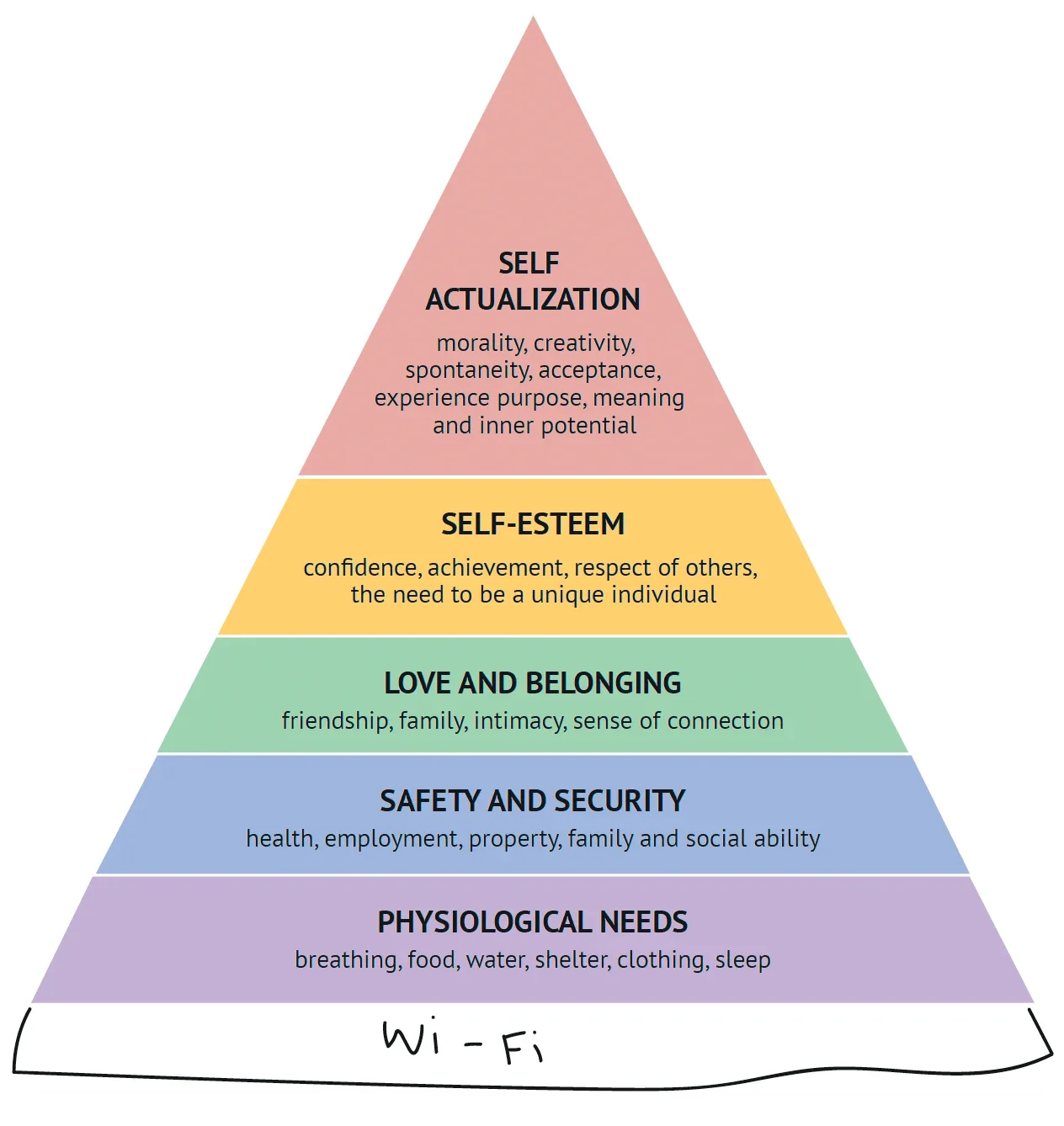
Maslow's pyramid in dollars
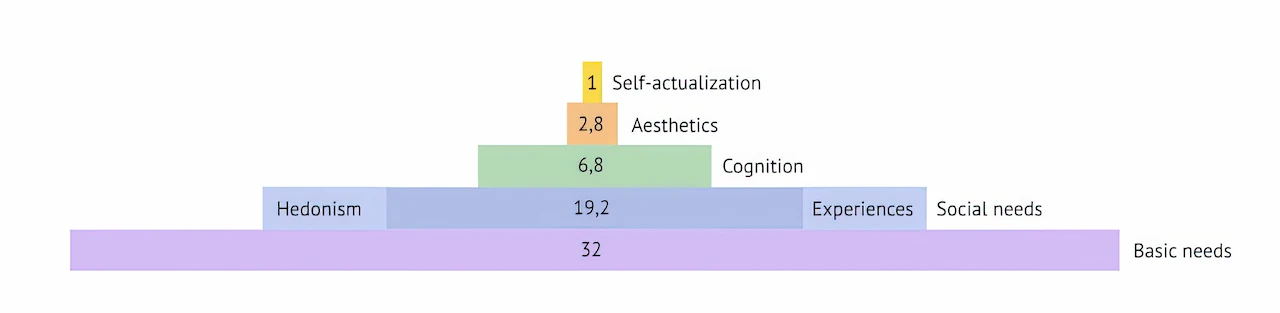
All numbers are in trillions of US dollars. The width of each section is proportional to spending at that level.
How many authors earn from donations?
3% of the authors registered on donation services. A fraction of a percent of all authors.
How much money do content producers entering the labor markets need?
Over $500 billion a year, on top of advertising revenue.
Demand is growing, because millions are joining the content sphere who have no place in the industrial economy or the service sector.
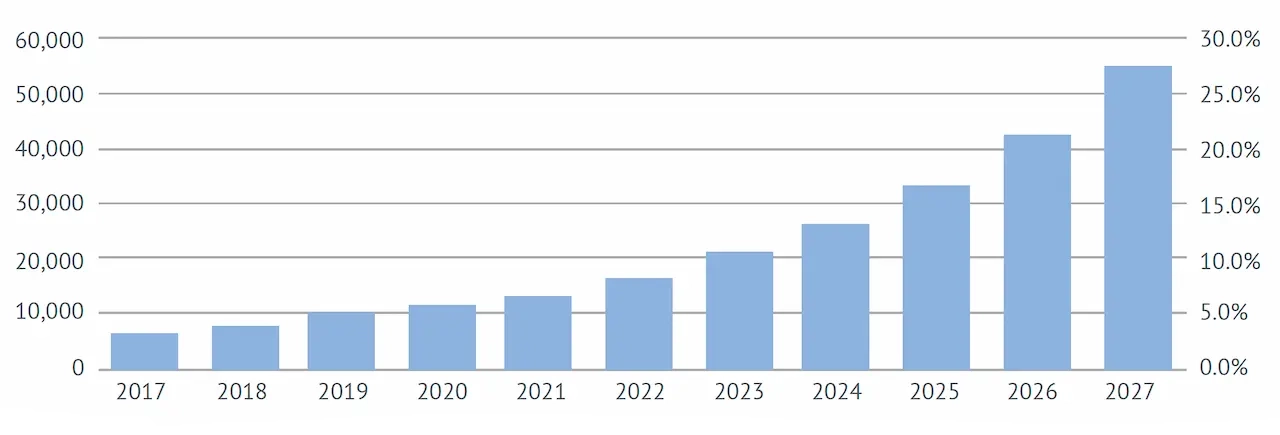
How large is the podcast market?
Global Podcasting Market size (US $ Mn) !
How big is the internet advertising pie?
$500 billion a year.
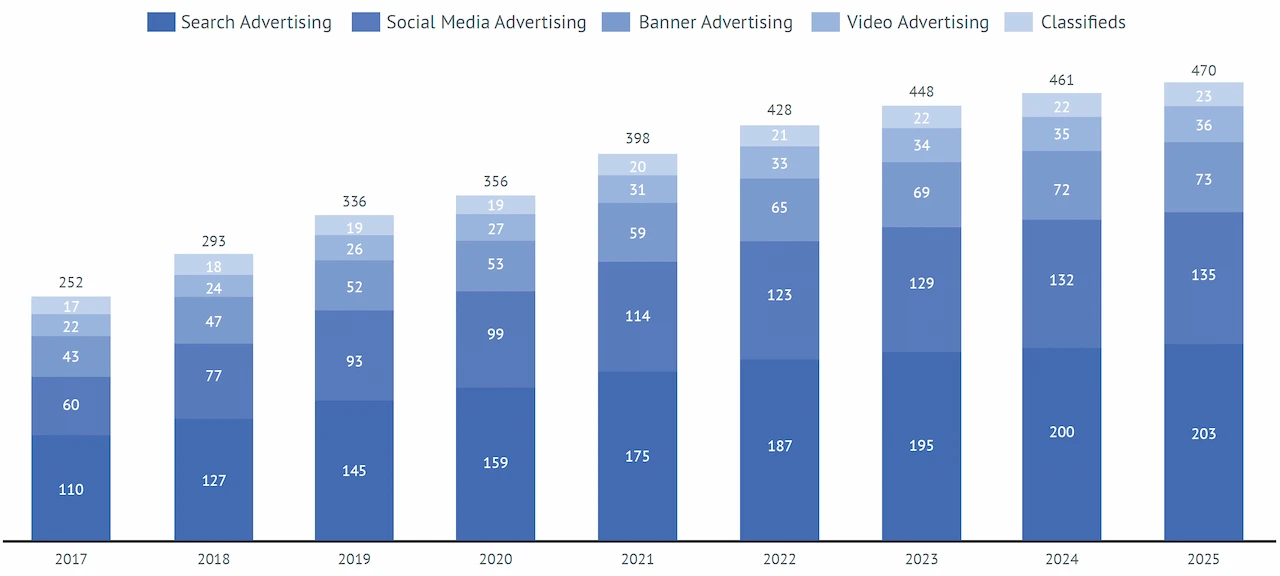
Ad revenue is growing 4–5% a year.
How are one-time donations different from sponsor subscriptions?
Both are called donations, though they're different things.
Subscriptions suit serial goods. One-time donations suit individual works. Both branches are valuable, each in its own way.
A targeted signal of quality (for what, exactly?) carried by a donation for a specific work contains more information than a subscription. The difference is the same as between an Oscar for a specific film and an Oscar for lifetime contribution to cinema.
It makes sense to back a sector analyst or a TV host continuously. That doesn't carry over to a beginning author. Pioneering, one-off content sits outside the coverage of the subscription model, and whether it's discovered is left to luck.
Another difference is ethical.
In spirit, serial donations (a monthly sponsorship of a creator) come close to a gift. But the business structure has arranged the relationship so the creator owes something to the patron, and the obligations are laid out by support tier.
Altruism has been fit to a "something for something" schema, which is why tax authorities classify donation subscriptions as commercial transactions: payment in exchange for access to content.
One-time donations are the higher form of altruism.
They sit entirely outside transactional calculation. The author owes the donator nothing in return, which removes the weight of forced reciprocity.
What's the right way to ask for one-time donations?
Don't ask.
Calls to the audience carry a faint taint of solicitation, a trace from traditional charity, where directly asking brings in more money. (Curiously, people who have paid for the right not to watch ads are forced to consume self-advertising.)
Asking contradicts the spirit of the relationship donations express.
Handing flowers to an artist is no less valuable than the artist receiving them. There's no petitioner in that exchange. When a person is nudged toward something that should come from the heart, external motivation crowds out internal motivation.
Which is better, one-time donations or subscriptions?
Both matter. Both are needed. One-time donations and serial sponsorship (subscriptions) are two equal branches of non-advertising monetization:
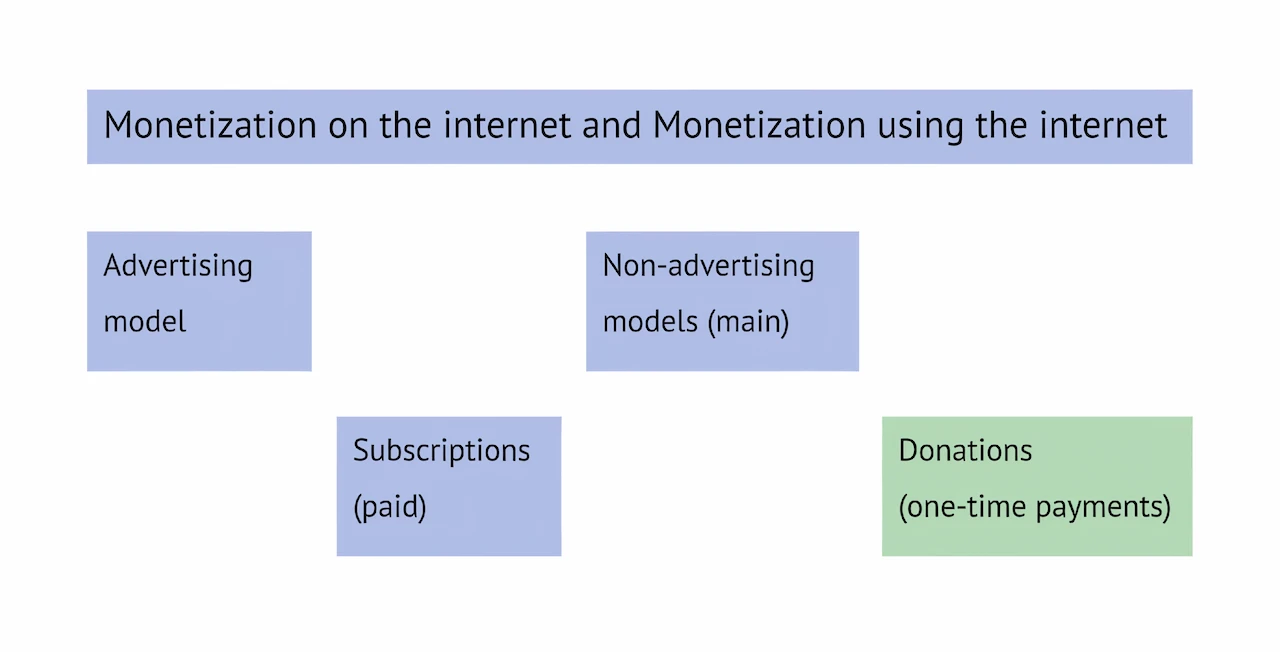
Donation-subscriptions suit serial products; one-time donations suit non-serial, singular work. Many producers, especially those starting out, need targeted support, and they won't get it until one-time donations become the norm.
Why do sponsor subscriptions dominate?
They provide predictable income and are convenient to run with popular authors.
If you want, you can force a one-time donation into a subscription schema: to send $30, you can pick a $5 tier for 6 months. It's awkward, no one actually does it, and the quality of the signal blurs.
Why don't people on Patreon donate for specific works?
At first, in 2014, they could. Patreon also showed users other authors, which matched its programmatic goal, "to free creators from having to survive."
But a conflict of interest emerged: the author brings their fans to the service, and the service redirects those fans to other authors, where the money can flow. The first cohort of authors protested, and Patreon shifted to sponsor subscriptions.
*Read more.* By sealing the audience off around the author who brought them in, a service reduces itself to a landing page for warm leads and a wallet vault whose promotion falls back on the wallet owners. There was a logic to this at the stage where the donation industry was forming. Today, though, authors compete less with each other inside their niches than with other participants in the attention economy. Spreading online patronage will give them a share of a growing pie.
DO bets on openness: we show authors in a full range of rankings and in personal recommendations.
Where is more money: in sponsor subscriptions or one-time donations?
That will become clear once we spread one-time donations and give them useful applications. Sponsor subscriptions are low-hanging fruit. But there's no "law of nature" that makes them larger than one-time donations.
What's the value of one-time donations?
They show the value of individual works. An author is rewarded not "on the totality of merits" but for specific achievements. That matters both for consumers (navigating content) and for authors themselves, who need to know what, specifically, moved people.
Why aren't one-time donations more widespread?
Because they're not yet embedded in a system that rewards making them.
We built that system. Its engine is donation rankings.
What's the financial potential of one-time donations?
Hundreds of billions, possibly trillions, of dollars a year.
How many wealthy people are there in the world?
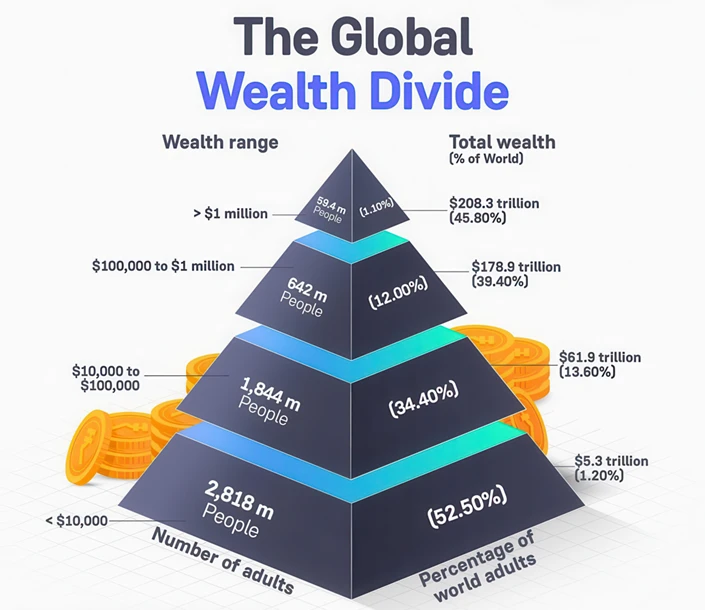
How many altruists are there in the world?
The Myth of the 2% Altruists
There's a common misconception that "nature" produces only a few altruists, setting a low ceiling for the practice of donating. It's false. When we reward the best in ourselves, it becomes the norm.
Today, those naturally inclined to donate, donate. Tomorrow, a second wave follows; the day after, a third. When donating becomes useful and fashionable, it goes mainstream. And people will wonder how it was ever any different.
Donations grow on two things: public visibility, and a fusion of pleasure and purpose. Donating is pleasant, once you try it. It's like discovering an organ of pleasure that had been dormant.
Who is Homo Donaticus?
A person who loves to give and donates from internal motivation.
There are tens of millions of them today. They're DO's bedrock, our potential early followers, who clear the path for everyone else.
What are altruism types I and II?
Altruism of the first type concerns support for the weak and the needy.
Altruism of the second type is "social glue." It's oriented toward creating obligations and mutual support.
What is altruism of type III?
Its only reward, and its leading motive, is the internal satisfaction of the person giving. That sets it apart from the value-based altruism of type I (the wish to help the needy) and the means-rational altruism of type II (expectation of a return benefit).
Type-III altruism is what drives donators. Its communication isn't top-down, as in type I, or horizontal, as in type II. It runs sideways and upward: a gift returned, without obligation.
One-time donations are a pure gift. "Pure" doesn't mean useless to the giver. The gift brings self-identification, self-respect, new social connections, and the discovery of "your people."
Key ideas, concepts, and terms
A glossary of the concepts the rest of this document leans on: adverse selection, the paradox of value, revealed preference, consumer surplus, user expertise, symbolic capital, self-reputation, the quality of subjective time, and the differences between donations, charitable giving, and tips. Definitions and how each one applies to DO follow.
What is adverse selection?
Adverse selection is when the worst win. It happens when the rules reward bad behavior and/or have gaps that allow dishonest play.
How does adverse selection work on information markets?
Bad texts are like weeds: undemanding, self-propagating. If you don't distinguish them and don't weed, they crowd out the cultivated plants.
Content sits on the shelves as a million labels without prices and without quality marks. In those conditions, assembly-line junk content takes over the attention shelves and crowds out content made by hand.
The consumer struggles to reach quality, and over time struggles even to assess it. Taste dulls and degrades.
A vicious cycle forms. Quality is hard to find → taste degrades → demand for quality falls → producing it becomes less profitable. And so on, down the spiral.
DO's task is to build the antidote to adverse selection.
Where does adverse selection operate?
Everywhere expertise doesn't block it.
Adverse selection was at work on economic markets. There it was recognized (George Akerlof, Nobel Prize 2001, see his article "The Market for Lemons: Quality Uncertainty and the Market Mechanism") and more or less neutralized through brands and quality guarantees.
It was diagnosed on information markets too (by the founder of DO, in Dolgin A., The Economics of Symbolic Exchange, 2008) but hasn't been treated. That's what DO addresses, using donations as markers of quality.
DO's donation rankings are the cure for adverse selection.
What are the symptoms of adverse selection on information markets?
Prices for books, films, music, blogs, and podcasts are flattened to a single level, so they don't say anything about quality and don't help consumers navigate. That's the paradox of uniform prices: money is supposed to measure value, but with content it can't.
The same goes for information sources. Their reliability is unclear. The same goes for content producers. Their income speaks to popularity, not reputation. It's unclear whom to trust and how much. Because of this, excessive resources are spent on choosing what to read, listen to, watch, and whose advice and services to use.
Why does content cost the same?
- Digital texts aren't rare, which is the main reason their prices are uninformative.
- Prices are born from competition for a scarce good. There, a price acts as a brake on purchases and carries information. Prices aren't arbitrary numbers. They're numbers at which supply and demand balance.
- On top of that, money is adapted to goods of regular demand, and content isn't like that.
- Repeat purchases show that a product suited many people. The very fact of shelf presence means the product more or less satisfies buyers; otherwise sellers would stock the shelves with something that sells consistently.
With books, tweets, or reviews this doesn't work. "Purchases" don't repeat, so there's no way to see how well expectations were met.
Low (effectively zero) reproduction costs for digital content, and non-repeatable consumption. These two traits of content break the price mechanism.
What is the paradox of value?
Useful goods like air or poems can cost nothing, because they exist in abundance. Other, maybe less useful but limited, goods have a price.
You don't have to compete for the right to read a poem. It's free. The poem's value doesn't go anywhere because of that, and it would be good to know whether that value is there at all.
The same goes for the value of any statement. Stripped of a physical medium, it loses scarcity, and with scarcity, an informative price.
That's the paradox of value, and it's the curse of digital production. Because reproduction costs are low, price doesn't depend on quality and doesn't reflect value.
A large share of what we consume falls under the paradox of value.
How do you resolve the paradox?
Our answer: donations.
Why user (crowdsourced, social) expertise instead of traditional expertise?
"Manual" expertise can't keep pace with content generation. Its throughput is nowhere near the thousand-fold growth in text output.
The solution: meet hyper-emission with equally high-output expertise, so one balances the other. The only path is consumer expertise.
User-generated content has to move hand in hand with user-certified content.
Why are donations money adapted to "the digital"?
As post-factum payments, donations are elementary signals of recognized quality.
People donate after consuming, which is what lets donations signal quality. Upfront payments leave the quality question open: you can't tell how well what a person paid for actually suited them.
By publishing donation rankings, we remove that uncertainty.
The difference between "before" and "after" sits at the root of money's measuring-signaling function. That's why donations are money brought up to date.
A donation is the third, closing act of an upgraded money-handling schema. It's a tail-end payment that signals the person got more than they expected and, out of gratitude, shares part of the surplus. (Economists call this consumer surplus.)
What is consumer surplus?
The gap between the price a person paid (in money, time, attention) and what they would have agreed to pay if they had known how well the product would fit.
Today, consumer surpluses are hidden. Donations make them visible. That's the key to mapping content by perceived value.
What is revealed preference?
Preferences shown in actions and choices, not in words and not in survey responses.
People don't say what they think, and don't do what they say.
DO relies on actions, and on costly actions expressed as donations, rather than on statements. That's why donations are a person's calling card in the digital world.
Why is value measured in money and not something else?
Value reveals itself in weighing, when a person decides what to receive and what to give up. Whatever valuable thing is given up has to have a standard measure, like time or distance, and has to be expressed as a number. Otherwise there's no way to compare exchanges others make, and no way to learn from their experience.
There is no other universal way. But this one doesn't apply to information, because information differs fundamentally from ordinary goods. (See "Why does content cost the same?")
Why are donations the future?
Because people's interests are shifting from "lower" needs to higher ones. And money, born in goods exchange, conveys the information about content poorly, because content is too easy to copy.
Money is a foundational institution of humanity in large part because of its ability to signal value. It loses that ability when the subject is the finer matter of the spirit.
*Read more.* Whatever the subject (happiness that refuses to rise despite what sociologists report, inequality, human dignity and the right to respect, the future of work, universal basic income, social ties, freedom of speech, civilizational clashes, the supposedly deadly threats from AI) there's an urgent need for a "system of weights and measures" for the intangible. Without it, it's hard to understand the practical meaning of "a lot" and "a little." As a result, we slide into "either/or," into extremes, when the optimum sits somewhere in between.
Hence point 1 on the information-society agenda: establish value-labeling for content. Its poor state is the defining pain of our time.
DO lets people tell good writing from toxic writing without having to taste everything. Monetary calibration of the higher-needs realm isn't a cure-all. But it's how we pull the right thread, loosen the knot of contradictions, and bring ourselves into line with the complexity of the world.
Is it worth donating for paid services, and what's the point?
A donation says the buyer received far more than they expected; that they ended up with a consumer surplus. It doesn't matter whether the person paid with attention or also with money. A consumer surplus can emerge either way. A donation is a way to signal this.
DO is built to make people want to do that, to make it pleasant and useful.
What's the difference between donations and charitable giving?
Charitable giving is uncompensated aid: humanitarian help, material support for someone, whether money, alms, clothes, toys, food, or donor blood.
Donations here are signs of admiration. (See the section on altruism of type III.)
What's the difference between one-time donations and tips?
Donations express gratitude and admiration.
Tips are often left following a social norm and/or a sense of moral obligation, and the awareness that service workers can't live without them. That's closer to an obligation than to thanks.
When a tip is included in the check, it becomes an obligation whose non-performance carries consequences. That has nothing in common with donations.
What is classified as donations today?
Almost anything: sponsor subscriptions, one-time donations (as on streams), donations to the needy, mandatory tips, fundraising on Kickstarter.
The donation practice is barely a decade old, so people, even experts, struggle to tell these things apart and lump them all together, sometimes even adding paid content.
Illustration: the industry pioneer Patreon is known as a donation service, is in fact a subscription service, and its legal status is "paid content provider."
What does "The Money is the Double Message" mean?
It's the title of a section in a book by Alexander Dolgin, the founder of DonateOpen. It lays out the fundamental thesis for donations, presenting them as a higher form of money and as its adaptation to the digital age.
The slogan plays off Marshall McLuhan's famous line, "The medium is the message" (the idea that the channel through which we receive information shapes our perception of the content).
"The double Message" conveys that on DonateOpen money is more than a means of exchange. It's also a carrier of information. Donations combine financial support with an assessment of quality.
The slogan is a shibboleth: a signal for the people "in the know," aimed at an intelligent, culturally aware audience.
What is self-reputation?
Reputation in your own eyes.
Like ordinary reputation, it's shaped by how a person lived and acted in the past, and, critically, by which of their own actions a person drew on to build the inner image of "I," from which they now predict their own behavior.
What is the quality of subjective time?
Subjective time (also known as psychological, internal, or personal time) is the intra-personal experience of objective time. It differs from chronological time.
Depending on their state, a person can either underestimate or overestimate duration.
Time full of events feels fast. Empty time feels slow and heavy. The urge to escape empty time explains low-quality consumption. Anything is better than nothing.
*Read more.* This has been discussed by Augustine of Hippo (in Book 11 of the Confessions), Kant, Husserl, and Bergson. It was experimentally confirmed in Wundt's laboratory in the late 19th century. Subjective duration is an increasing function of the quality of time.
Can a person assess the quality of their own time and express it in a donation?
Yes. It's the pre-installed software of Homo sapiens, activated the moment Adam and Eve tasted the fruit of the Tree of Knowledge of Good and Evil.
Every person knows, internally, whether they're content with a stretch of lived time, and how much. Every person is capable of expressing that judgment in stars, in points, or in money.
Inner monitoring of the quality of lived time happens regularly or not, well or poorly, with or without memory. But the fact is that Homo sapiens notes the quality of time. It's an inborn, developable capacity. DO's social experiments confirmed it.
What is symbolic capital?
The capacity to produce high-quality time by creating texts: statements of every kind.
The more valuable the texts, the higher their contribution to high-quality time, and the higher the producer's symbolic capital.
From the standpoint of producing high-quality time, symbolic capital and symbolic values are related concepts. The first is potential; the second is its realization.
Who has symbolic capital?
Everyone.
Whether we want it or not, we all produce texts and influence (in the broad sense). Depending on their value, those texts produce time of a certain quality in other people, positive or negative.
A politician, a public figure, a journalist, an analyst, a writer, an artist, an architect, a performer, a creative collective (as a whole and each of its members), an athlete, a blogger, a teacher: all of them have this form of capital.
The list isn't limited to elites and professional producers of culture. To one degree or another, everyone has it, because everyone influences those around them. Real estate agents, car salespeople, service workers, social media users, people on the spectrum.
How do you determine symbolic capital?
The same way business determines a company's monetary capitalization: from projected profit.
It's an adaptation of the fundamental idea about the connection between economic capital and the flow of money it generates. The first (invisible) can be assessed through the second (observable). In biblical terms: "by their fruits you will know them."
A chain forms: "symbolic capital → symbolic product → the quality of a person's lived time (the symbolic effect)." Starting from the end, you can work back to the beginning: from the quality people perceive, to values; from values, to symbolic capital.