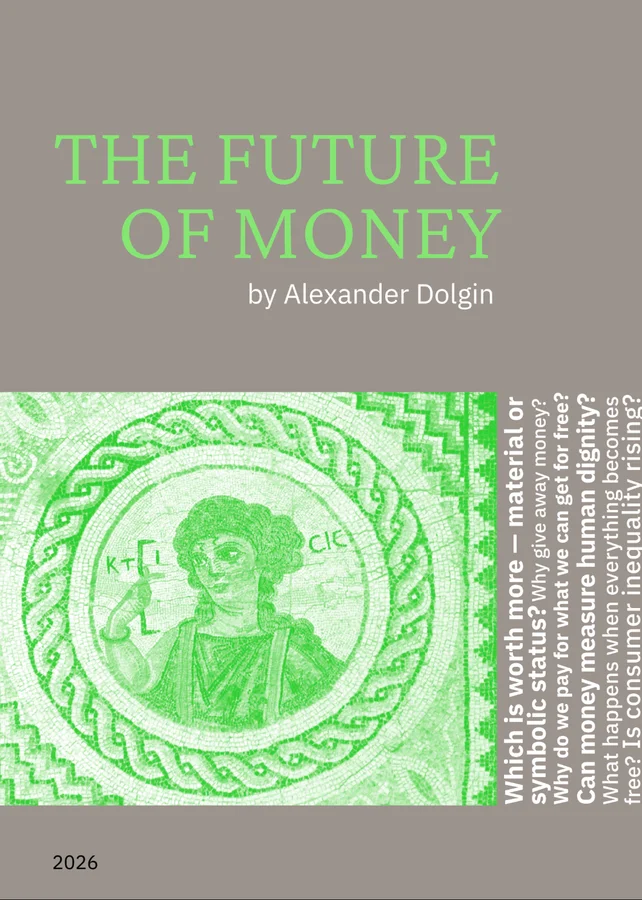
THE FUTURE OF MONEY

Created at: Jul 20, 2026 Release date: Apr 10, 2026
Almost all digital content costs about the same - so price no longer tells you what is good. When everything is a click away, and nothing is scarce, money stops doing its oldest job: signaling value. In The Future of Money, economist Alexander Dolgin diagnoses why money breaks down online - and proposes a deceptively simple fix. Prices work because scarcity works. But texts, music, podcasts, and ideas copy at near-zero cost, so uniform pricing collapses and audiences are left guessing. The result is adverse selection - the market failure George Akerlof, Michael Spence, and Joseph Stiglitz won the Nobel Prize for describing. Junk crowds out quality, taste erodes, and creators chase attention instead of value.
The book describes the main directions for the development of the digital society. The author angles its book to those who are interested to know what would replace search engines, and how social networks would evolve; what profit can be made of different forms of informational collaboration
Alexander Dolgin’s Economics of Symbolic Exchange is in reality not one but three books, and although these semantic layers are interlinked, the reader will need to choose between the different vectors and modalities. One clearly evident dimension is research. Certain authors introduce quite new intellectual approaches into scientific debate. This requires a special frame of mind and a searching curiosity about social reality. Carl Gustav Jung identified a phenomenon which he called systematic blindness: when a science reaches a stage of maturity and equilibrium, it categorically refuses, from a sense of self-preservation, to note certain facts and phenomena which it finds inconvenient. In Alexander Dolgin’s book, whole complexes of such “non-canonical” material are to be found.